Gen Wang is the fourth commander to head the Western Theatre Command after the eastern Ladakh standoff began in May last year.
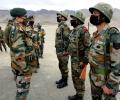
India and China have held several rounds of talks at the diplomatic and military-level to resolve the standoff that erupted in early May.
President Xi, who heads the Central Military Commission (CMC), the overall high-command of the two million-strong People's Liberation Army (PLA), appointed Gen. Zhang Xudong as the Commander of the Western Theatre Command, according to the official media in Beijing.

The state-run Global Times newspaper quoted the People's Liberation Army Western Theatre Command spokesperson as saying that "Indian troops again crossed the line of actual control in the Galwan Valley region and purposefully launched provocative attacks, leading to severe clashes and casualties."

Besides being the President, 62-year-old Xi is already General Secretary of the ruling Communist Party and Chairman of the Central Military Commission.

Gen Singh, who is accompanied by a high-level military delegation, is scheduled to meet a number of high-ranking dignitaries of Peoples Liberation Army and Central Military Commission during his visit from November 21-24.

'The military officers at China's National People's Congress reflect Xi Jinping's preference for elevating politically reliable, younger, officers with good professional qualifications,' says former RAW officer and China expert Jayadeva Ranade.
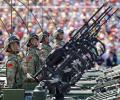
The move took place late last month and involved hardware being moved simultaneously by road and rail from across the entire region.
Terrorism and insurgency in J&K had subsided when India demolished East Pakistan -- for the simple reason that Pakistan understands power. We need to follow Chanakya's dictum of Saam, Daam, Dand, Bhed for strategising against Pakistan, asserts Lieutenant General Prakash Katoch (Retd). The ground truth is that unless we are prepared to acknowledge our shortcomings, including massive intelligence failures, punish those responsible and take corrective actions, we will continue in the same vein, asserts Lieutenant General Prakash Katoch (Retd).
'A hotline between the Chinese and Indian military establishments is essential if the possibility of conflict is to be minimised.' 'When relations are uneasy, even minor incidents can spiral out of control,' warns former senior RA&W officer Jayadeva Ranade.

Chinese President Xi Jinping, who made a rare visit this week to the restive Xinjiang region which borders Ladakh, met the troops and officers stationed there and praised their "outstanding contributions" to the border defence and stabilisation of the volatile province.
According to the 'Military and Security Developments involving the People's Republic of China' report 2023: "Since early May 2020, sustained tensions along the India-China border have dominated the Western Theater Command's attention."

16 Indian Army divisions face China, 20 face Pakistan and two divisions are reserves. This powerful signal can hardly be missed in China or Pakistan, notes Ajai Shukla.
The intrusions into India were likely carried out by the PLA's better trained and equipped 'mobile operational units'.

About 30 airports have been either built or under construction in Tibet and Xinjiang provinces which will boost China's civil and military infrastructure in the remote regions bordering India, the country's official media reported.
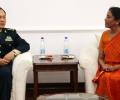
The two sides also decided on early operationalisation of the proposed hotline between the two armies as part of the confidence building measures, the defence ministry said.

The Indian Army bravely prevented the Chinese PLA's attempts to unilaterally change the status in the Yangtse area of Arunachal Pradesh's Tawang sector on December 9 and confronted it with firmness, Defence Minister Rajnath Singh said on Tuesday.

At a media briefing in Beijing, Chinese Foreign Ministry spokesman Wang Wenbin said the two sides have maintained smooth communication on border-related issues through diplomatic and military channels.

Indian Army officers are convinced China is maintaining the pretence of dialogue and negotiations in order to create the opportunity to occupy more Indian territory. Senior Indian planners apprehend this might be a Chinese ploy to divert attention from Depsang, in Northern Ladakh, which might be China's actual target.

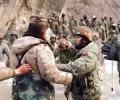
Army Spokesperson Colonel Aman Anand said troops from China's People's Liberation Army (PLA) 'violated' the consensus arrived at during military and diplomatic engagements on the ongoing standoff in eastern Ladakh, and carried out provocative military movements to change the status quo.

'Galwan has turned everything.' 'The casualties on both sides alerted the Chinese to the fact that Indians are not going to take it lying down.'

According to official sources, the primary objective of Wei's visit is to deliberate with Indian defence establishment on implementation of decisions taken by Modi and Xi in their informal summit in Wuhan in April.

The 2.3 million strong People's Liberation Army, the world's largest, adopts a more aggressive posture with massive structural revamp.

Major General Sujan Singh Uban, a legendary veteran of the Second World War, was a natural choice to raise, train and command the Special Frontier Force and mould them into a well oiled fighting machine, recalls his son Inspector General Gurdip Singh Uban (retd), who led SFF troops during the Kargil War.

Amid tensions over build-up by the Chinese across the Line of Actual Control (LAC) in Eastern Ladakh and reluctance to resolve remaining issues between the two countries, Indian Air Force (IAF) chief Air Chief Marshal VR Chaudhari is visiting forward areas in Ladakh to review the operational preparedness of troops deployed there.

'With continued focus on votes, upcoming by-polls and purchasing politicians, the political hierarchy has little time for national defence.' 'They would do well to heed a veteran scholar, who says, "There will be war with China in the next few years. The next full scale war will have the involvement of Pakistan and terror elements, insurgents and intelligence assets operating inside India",' warns Lieutenant General Prakash Katoch (retd).

DRDO's failures over the decades have contributed significantly to India becoming the world's biggest weapons importer, points out Lieutenant General Prakash Katoch (retd).

China's closer and enhanced relationship with Pakistan is putting considerable strain in India-China relations, says former RA&W officer Jayadeva Ranade.

China will flood direct flights to India with wholesale takeaways of the authentic stuff; Indian businessmen will fight for the commission and the consumers for the cuisine, predicts Sunanda K Datta-Ray.

In a few years from now, India will be looking at an entirely different type of military adversary across the borders, in our waters, in the air, in space and in our communication networks, says Nitin Pai.

The Chinese military, on the last day of its largest-ever military exercises to vent out its anger over United States House Speaker Nancy Pelosi's visit to Taiwan, carried out island saturation attack drills in the Taiwan Straits, amid global concerns of a full-scale attack to annex the breakaway island which Beijing claims is part of its territory.

The arrival a couple of days ago of a Chinese nuclear submarine for the first time in Karachi port, coinciding with a Chinese military delegation's visit, points to Pakistan's importance for China, says former R&AW officer Jayadeva Ranade.

China plans to divert about 200 billion cubic metres of water annually from the Brahmaputra at its highest point, namely the Great Bend, where it turns into India. China's Brahmaputra dam will severely impact India, warns former senior RA&W officer and China expert Jayadeva Ranade.
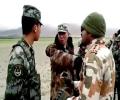
'During disengagement, you don't find violence.' 'And that, too, the killing of a commanding officer.' 'This indicates that this is more serious than previous incidents.'

'However, a lot of preparatory work would have to go in and China must be prepared to announce an end to the standoff by disengaging from the remaining areas along the LAC.'

'All the government needs to do is to identify clear political and strategic objectives and to give the military planners a free hand,' asserts Ajai Shukla.
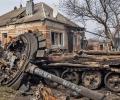
'The wise men learn lessons in war.' 'The smart men learn lessons from others, it's only the foolish who learn the wrong lesson.'

The Chinese Communist Party's all important 19th Party Congress is just months away, and President Xi Jinping finds himself confronting unlikely challenges to his pre-eminent position, says former RA&W officer and China watcher Jayadeva Ranade.

The massive earthquake in Sichuan struck at 9:19 pm (local time) on Tuesday and the epicentre was monitored at a depth of 20 km, state-run Xinhua new agency reported.
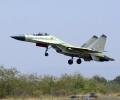
'We should have seen these signals and reacted earlier.' 'We miss out on a certain strategic advantage by arriving late on the scene.'
 © 2026 Rediff.com - Advertise with us - Disclaimer - Privacy Policy - Sitemap - Feedback - About us - Terms of use - Grievances